No serious workshop quotes flat rates for one-off pieces. After we have seen the work — in the workshop or from photographs — you receive a binding quotation.
How long until my new framing is ready?
As a rule it takes one to two weeks for your new frame and the framing to be finished. Talk to us if it needs to be quicker.
How long does a restoration take?
From a few days (simple framing) to several months (an extensive painting treatment). We give the timescale with the quotation.
Do I need an appointment?
We prefer to work by appointment — that way the person who knows your job is there and has time for you. You are welcome without one as well: Monday to Thursday from 8am to 4pm, Friday from 8am to 2pm.
Delivery and transport
Can I simply bring my picture in?
Choosing the right frame against the work itself matters a great deal. So yes — bringing your picture or painting with you is expressly welcome.
Do you collect objects as well?
Yes. Safe collection and delivery are part of the service — including for large-format and fragile works.
Do you advise on site?
If you wish, we come to you — chiefly worthwhile when the future hanging position should have a say in the choice of frame.
Insurance and value
My picture has been damaged — what now?
Change nothing on the object, photograph the damage, inform your insurer, call us. We draw up the condition report and the quotation in the form insurers expect.
The craft
How do I recognise genuine leaf gilding?
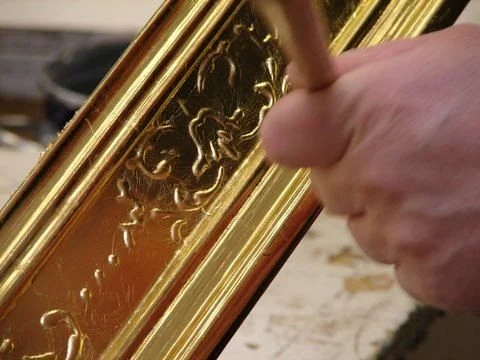
Real water gilding has depth. At edges and worn places the red bole shows through, and the burnished surface reads warm rather than flat and metallic. Bronze powders and gold paint age differently — patchy and dull.
Our frames are one-offs, carved and finished after assembly — no mitre joints are visible. Leaf-gilded frames can be told by the laps, the overlaps of the gold leaf along the moulding.
Do you also restore frames that did not come from you?
Of course. Where it came from makes no difference — condition and substance decide.
Glossary
The language of the craft
Bole, laying the leaf, craquelure: anyone dealing with a workshop like ours runs into words that are rarely heard outside it. Here they are explained — searchable by initial letter, subject or keyword.
Search
Subject
Letter
40 of 40 terms
Agate burnisher
Tools
The semi-precious stone used to bring water-gilded precious metal to a high gloss after the leaf has been laid. The stone compacts the bole beneath the metal leaf — for maximum shine and the look of solid metal. Also called an agate stone or burnisher.
Animal glue
Materials
An adhesive of animal origin, usually from hide or bone, and the binder in gesso and bole. Rabbit-skin glue and hide glue are the common kinds. It stays reversible — soluble with moisture and warmth, which is what makes it indispensable in conservation.
Bole
Materials
The fine clay ground laid as a burnishable base under gold leaf, and the glue-bound clay layer that sits directly beneath the leaf. The commonest colours are red, black, ochre and white, though any bole colour can be mixed for a particular piece. That colour governs the finished impression, above all where the gold is artificially aged or rubbed through, and it is what allows the gilding to be burnished at all. German distinguishes Bolus, the material, from Poliment, the prepared layer; English calls both bole, sometimes burnish clay.
Conservation framing
Frames
Framing designed to preserve the work over the long term: acid-free materials, spacers to hold the work clear of the glass, UV-filtering glazing and a dust-tight seal. Also called museum framing or archival framing.
Conservation glazing
Materials
Anti-reflective glass with a UV filter, for conservation framing. It removes almost all reflection and slows the fading of light-sensitive pigments. Also described as non-reflective or UV-filtering glazing.
Craquelure
Condition
The network of fine cracks that forms in a paint layer or a finish through ageing and movement of the support. Fine craquelure in an older painting is normal; lifting edges are a warning sign and call for consolidation.
We also offer finishes using a crackle gesso: the ground opens in a controlled way as it dries and produces an aged look — a finish only a few workshops offer.
Dutch metal
Materials
Base metal leaf of brass or copper alloy, close to gold in appearance; also sold as imitation gold leaf or composition leaf. Considerably cheaper, but it tarnishes without a protective coating and is not suitable for exterior surfaces.
Exterior oil gilding
Technique
The gilding of objects exposed to the weather — tower finials, weather vanes, inscriptions. High-carat alloys and weatherproof gold size are used here.
Finish
Technique
The coloured or metallic surface treatment of an object — on frames, sculpture and furniture. A finish comprises the ground, the colour or metal layer and the final treatment. On polychrome sculpture the same thing is called polychromy; German uses one word, Fassung, for both.
French polish
Technique
A shellac polish built up by hand in many thin coats. It gives the deep, warm shine of historic furniture surfaces and can be repaired in part rather than stripped.
Gesso
Materials
A priming mass of whiting and animal glue. It is applied warm, sets with some flexibility and can be sanded to a surface as smooth as ivory. Known in German as Kreidegrund, chalk ground.
Gilder's cushion
Tools
A padded board covered in leather on which metal leaf is laid out and cut. A parchment screen shields the leaf from draughts.
Gilder's knife
Tools
A long knife, deliberately not sharpened, for cutting metal leaf on the cushion. It parts the leaf by pressure rather than by cutting.
Gilder's tip
Tools
A wide, flat brush of soft hair used to pick up and guide metal leaf during gilding. The static charge in the hair holds the leaf until it touches the wetted surface.
Gold leaf
Materials
Gold beaten into leaves of extreme thinness, usually thinner than a ten-thousandth of a millimetre. Depending on the alloy the colour runs from reddish through yellow to greenish; higher carat figures are more intense in colour and more weather-resistant.
Ground
Technique
The build-up of layers between the support and the finish, classically of chalk and animal glue. It is applied in several coats and sanded back — this is where the smoothness of the later gilding is decided. Also called the priming.
Incising
Decoration
Cutting lines and patterns into the ground before gilding. The gold later follows the recess, which makes ornament read as relief. Sometimes described as engraving the gesso.
Laying the leaf
Technique
Setting the metal leaf down on the bole surface. The leaf is picked up from the cushion with the gilder's tip and placed in a single movement; a draught is enough to lose it.
Lining
Restoration
Strengthening a weakened canvas by mounting the original onto a second fabric to stabilise it — also called relining or doubling. A far-reaching intervention, carried out today only when gentler measures are not enough.
Matt gilding
Technique
Gilding without a final burnish. It reads quieter and more velvety than burnished gilding and is often alternated with polished areas to articulate mouldings and ornament.
Metal leaf
Materials
The collective term for all metals beaten into leaf: precious metals such as gold, silver and platinum, base metals such as copper and aluminium. Base metal leaf tarnishes and needs a protective coating.
Mitre
Technique
The angled joint between two lengths of moulding, usually at 45 degrees. Its precision visibly decides the quality of a frame — above all on glossy finishes. Spelt miter in American usage.
Mount
Materials
A cut board surround between the work and the glass, cut from mountboard. It holds the sheet clear of the glazing and gives it visual room; for archival quality it must be acid-free. Called a mat in American usage, and a passe-partout in continental Europe.
Oil gilding
Technique
Gilding onto oil size. It cannot be burnished and stays matt to satin, but it is hard-wearing and suitable for exteriors — on tower finials, gates and façades.
Oil size
Materials
The adhesive used in oil gilding — a drying oil with a defined open time, also called mixtion or gold size. The leaf is laid when the size is only just tacky; judging that moment comes with experience.
Ornament
Decoration
An applied or carved decorative element on a frame. Recurring motifs such as the acanthus leaf, bead moulding or egg-and-dart make it possible to place a frame in period and style.
Pastiglia
Decoration
A traditional technique of the late medieval period and the Renaissance in which relief decoration is applied to the surface with a thick gesso paste and then gilded. After gilding the ornament stands proud of the surface. Known in German as Aufsetzarbeit, raised work.
Punchwork
Decoration
Striking patterns into the gilded surface with punches. The recessed points break the light differently from the smooth ground around them and so create contrast without colour. Also called punching or tooling.
Retouching
Restoration
Closing losses in a paint layer with colour. Proper retouching stays confined to the loss itself and is reversible — it must remain recognisable to later conservators. Conservators also call it inpainting.
Reverse glass gilding
Technique
Gilding applied to the back of a sheet of glass and viewed through it — the technique known as verre églomisé. It gives mirror-smooth gold surfaces, used for lettering, mirrors and ornament.
Reversibility
Restoration
The governing principle of modern conservation: every intervention should be removable again with reasonable effort and as little residue as possible. It is what separates conservation from repair.
Sgraffito
Decoration
A smooth surface laid with real gold leaf is covered with a thin, supple layer of colour. The colour is then scratched away again to a drawing with a needle or a stylus of wood or bone, so that the shining gold appears as fine lines. Called Radieren in German; not to be confused with etching.
Silver leaf
Materials
Silver beaten into leaf. It gives cool, light finishes, but it oxidises in air and is therefore coated, deliberately toned, or allowed to oxidise under control.
Stretcher
Frames
The wooden construction a painting canvas is stretched over, made up of stretcher bars. Driven keys allow the tension to be adjusted — a frequent starting point when dealing with deformation.
Toned glaze
Materials
A transparent coloured glaze over metal leaf, sometimes called a lustre. It tints the metal surface without hiding it, and can make silver read as gold or gold appear warmer.
Toning
Technique
The deliberate ageing of a finish by tints, glazes and mechanical working — also called distressing. It settles new work into historic material without using pigment dust to fake a false date.
Tray frame
Frames
A frame in which a narrow shadow gap is left between the work and the moulding. The picture appears to float; the form is especially common for contemporary painting on stretchers. Called a floater frame in American usage.
Varnish
Materials
The transparent final coating on a painting. It saturates the colours and protects the paint layer, but it yellows over the years and can be removed and renewed in conservation.
Water gilding
Technique
The classical burnished gilding, laid on gesso and bole with a water and alcohol mixture and burnished with the agate. It gives the deepest shine of any gilding technique, but it is delicate and belongs indoors.
Zwischgold
Materials
A historic composite leaf of gold and silver beaten thin together — part-gold. It was cheaper than pure gold leaf, but it oxidises through the silver side and is today chiefly of interest in conservation.
There is no entry for this selection. Try another keyword.
Your question or your term not here?
Ask us — we are glad to explain what we do and why.