Giving the angel his face back
Two carved angel heads whose finish had been flaking for decades. The real question was not how to refinish them — but how far one may go in doing so.
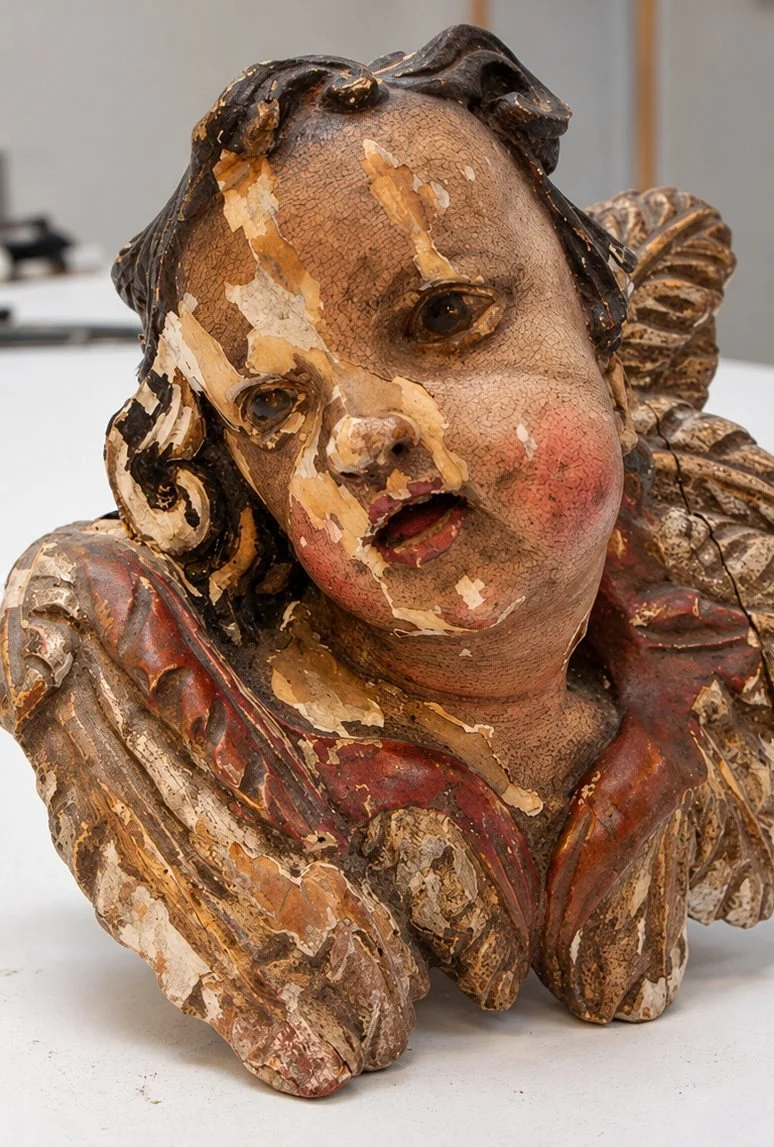
The findings
Across the face the finish was missing in large flakes. What was left stood away brittle and would have come loose at the next knock. Under the losses lay pale gesso, beneath that the bare lime wood — and at the edges still the original carnation, the finely toned flesh painting that is what gives a carved face its expression.
On the wings, by contrast, the old gilding was holding right down into the carved feathers. One object in two states: that is what makes the decision hard.
Three layers, three trades
A polychrome sculpture is not painted wood. It is a layered structure in which every layer has its own task. On the wood lies the gesso, which smooths the carving without losing its form. Over that the carnation for face and hands — a thinly glazed painting that suggests skin rather than depicting it. And on hair, robe and wings the gilding or silvering.
What brings an angel’s face to life sits in a layer tenths of a millimetre thick.
If one of those layers fails, the whole effect collapses. That is why with sculpture it is not the technique that decides the result but the order: consolidate what is holding — and make good only where the loss destroys legibility.
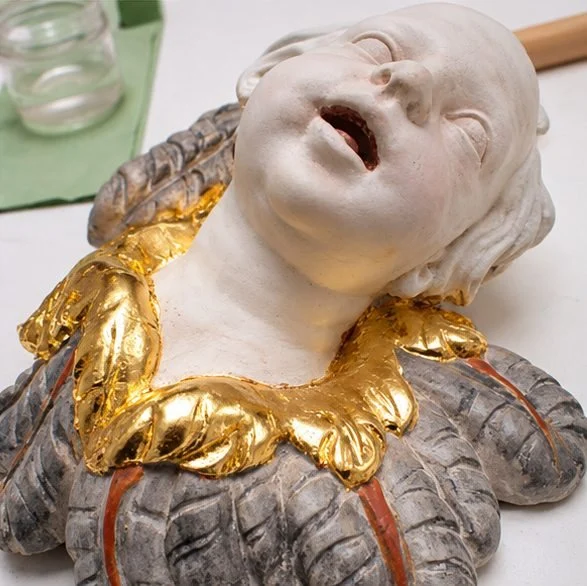
A new finish by an old method
The build-up follows the same path as on a frame: gesso in several layers, sanded until the carved edges stand sharp again, then bole, then the gold leaf. What is routine on a straight moulding becomes a test of patience on carved feathers — every undercut has to be laid individually.
The carnation comes last. It is not applied opaquely but built up in thin glazes, until the cheeks take on colour without the brushstroke showing.
The result
Side by side it becomes clear what was at stake. Both heads are the same carver’s work, and both should read as a pair again — without one looking like a copy of the other.
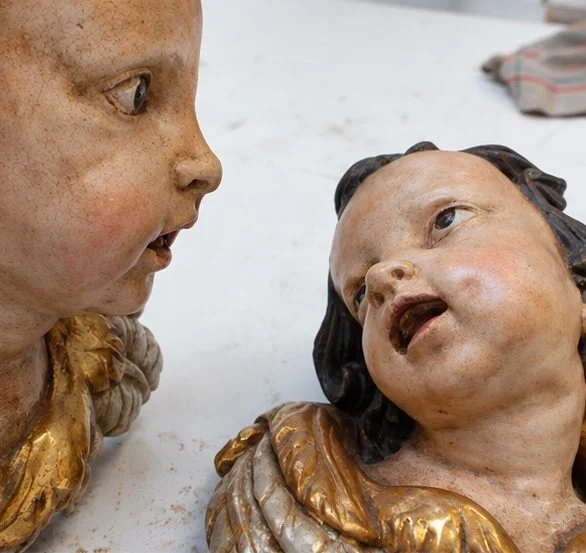
Restoration here does not mean producing an as-new condition. It means giving the object back enough that you can see again what the carver meant — and little enough that his work remains the main thing.
Ecclesiastical objects, figures, candelabra: we consolidate the finishes that are there and make good only where the loss destroys legibility — reversibly and traceably.
Submit an objectA figure that means something to you?
Bring it in or send us photographs — we will tell you what is needed and what is not.