How much colour a varnish swallows
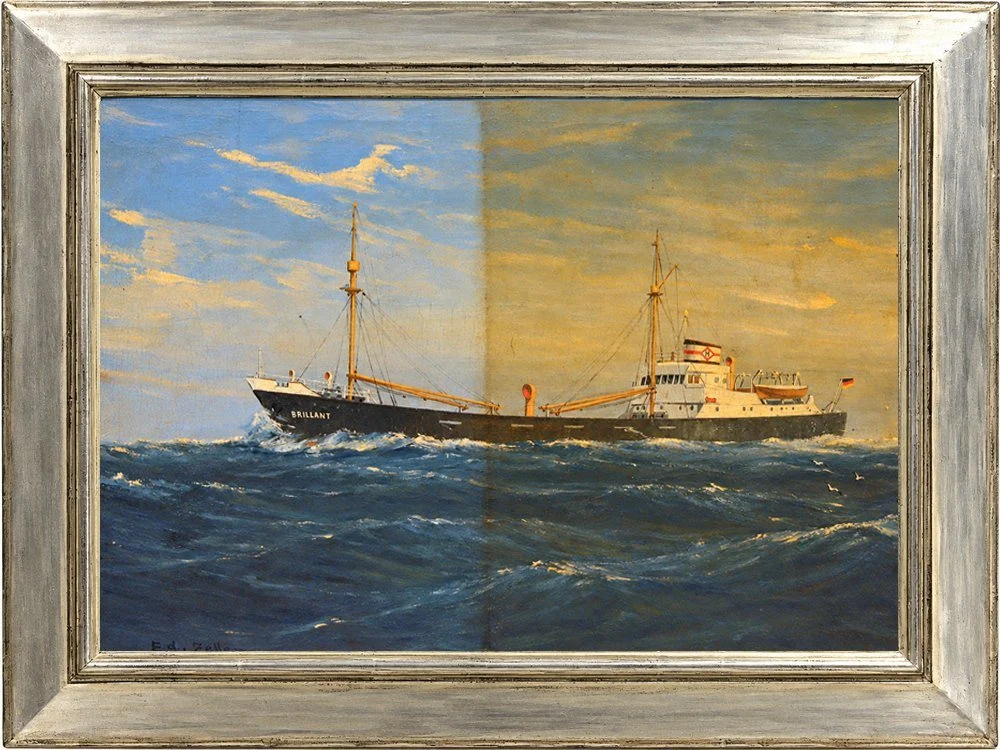
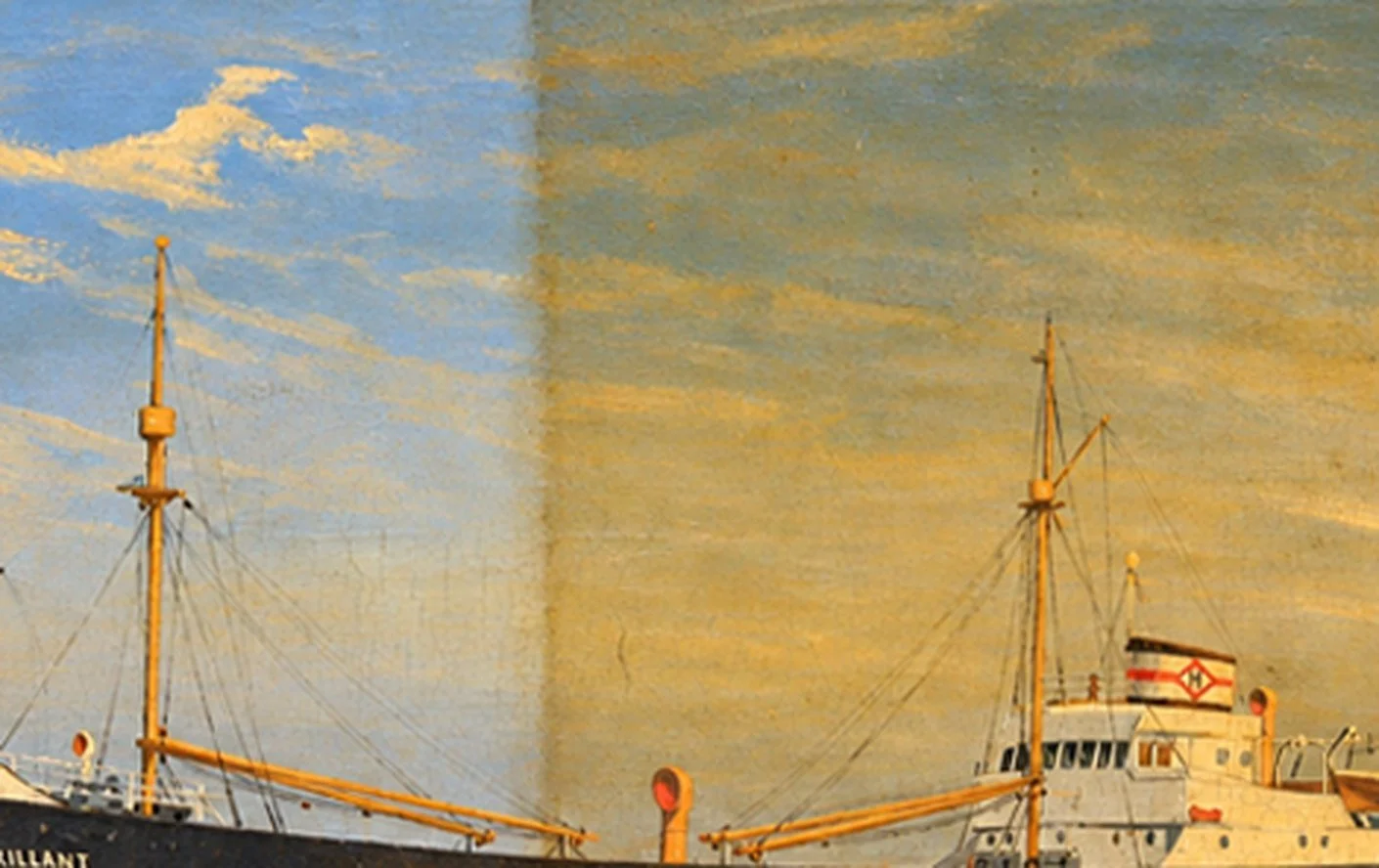
On one marine painting it could be shown to the millimetre: a cleaned test patch on the left, the old varnish on the right. Between them an edge that explains more than any description.
The findings
A cargo ship in heavy seas, oil on canvas, in a rubbed silver frame. Over the paint lay an even, warm yellow veil. The sky stood golden brown instead of blue, the spray glowed gold instead of white, and the white superstructure had turned to ivory. Seen face on, a fine craquelure covered the whole surface — the network of fine cracks that every aged oil painting develops.
The yellowing was not damage to the painting. It lay on top of it.
Why a varnish turns yellow
The varnish is the topmost layer of a painting. It protects the paint from dust and abrasion and at the same time saturates the colours — freshly applied, it makes darks deeper and glazes clearer. Traditionally it is made of natural resins such as dammar or mastic, dissolved in turpentine.
It is not the paint that ages, but what protects it.
Those same natural resins cross-link under light and oxygen. They yellow, lose transparency and turn brittle. The thicker and older the layer, the more blue it swallows — and in a seascape blue is half the picture. The oil paint underneath ages far more slowly. That is why the findings in such cases are seldom dramatic: the colours are there, you simply cannot see them any more.
The test decides, not the guess
Before anything is taken off comes the cleaning test. In an inconspicuous place we test which solvent will soften the varnish without attacking the paint layer — in stages, from the mildest upwards, with a cotton bud and under constant observation.
The result is this edge. It is the most honest basis for a decision there is: both sides see what will come out before the work begins. If the test shows that removal would put the glazes at risk, it is not done. That happens — and then the test is the reason to say no.
Removal, retouching, new varnish
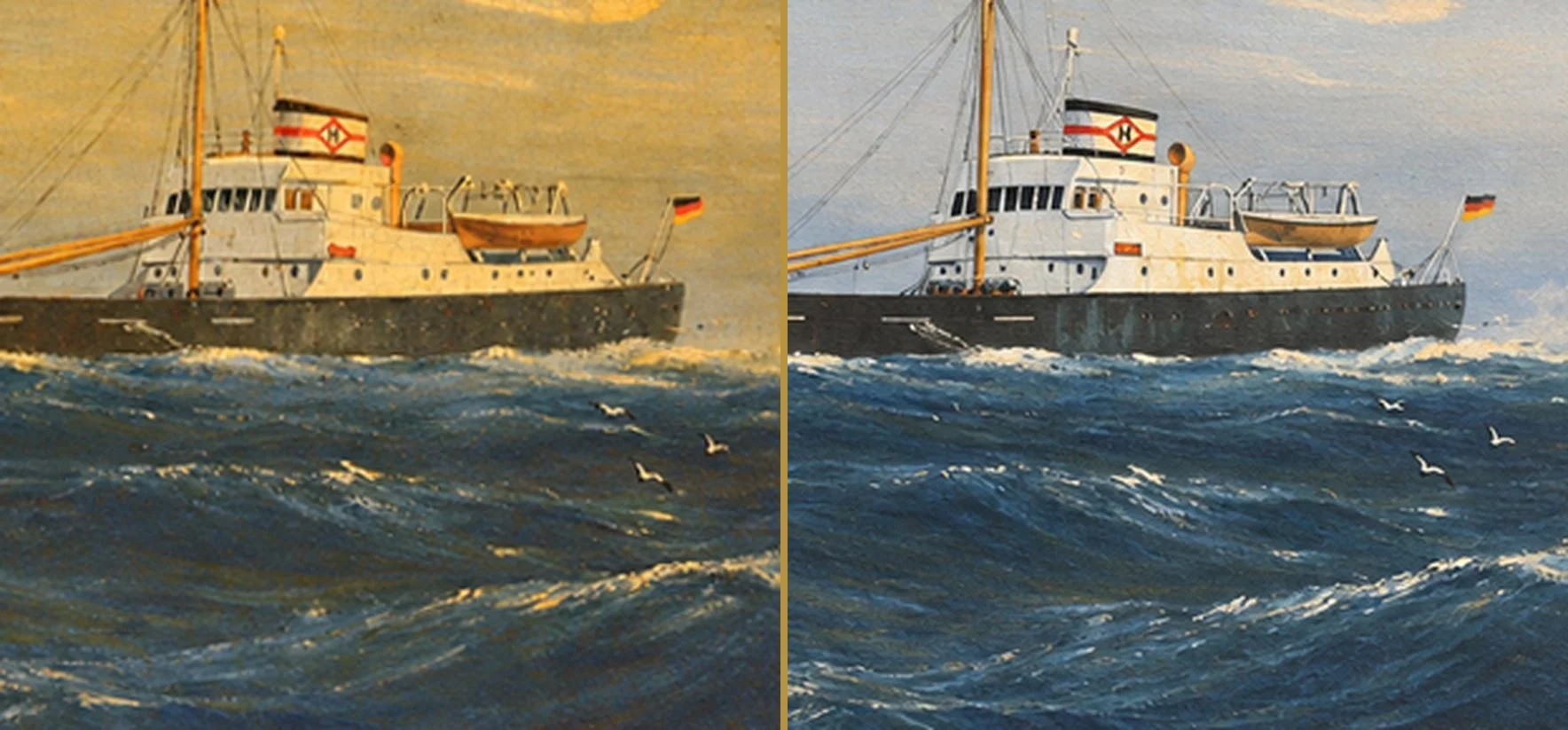
Removal proceeds field by field, not in one pass. That way a reference area is always left standing, against which you can read how far you have got. What becomes visible is not only colour but earlier interventions as well: overpaint, older retouching, losses that were filled before.
Anything added afterwards goes only into the losses themselves, over an isolating layer and in materials that can be taken off again. Retouching should make the picture legible, not blur the picture’s history — whoever works on it later must be able to tell what is original and what is not. Last comes a new, stable varnish that serves the same purpose as the old one and can likewise be removed again.
The result
Drag the slider across the picture — on the left the state with the test patch, on the right the finished work.
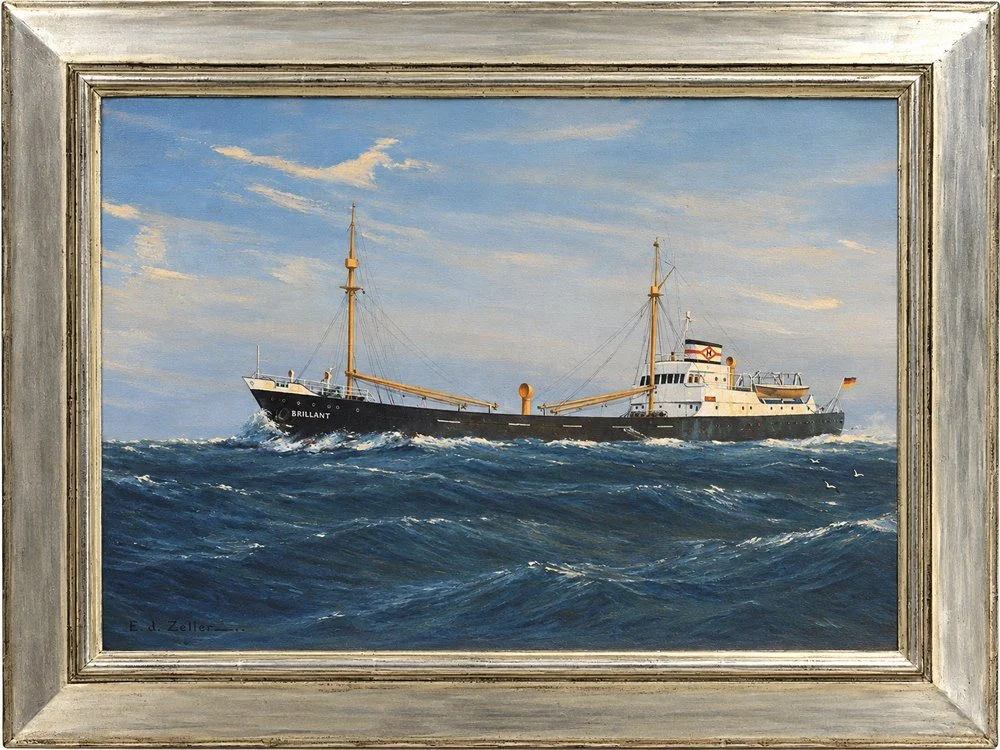 With test patchFinished
The frame stayed as it was. A rubbed silver frame suits a seascape better than any gilding — and a frame that belongs to a picture is not swapped out just because the picture is luminous again.
A picture that has gone dull? Send us photographs. We will tell you in advance what a cleaning can achieve — and when we would advise against it.
Submit a paintingA painting you have never really seen?
Often there is only one layer between you and the colours. We will test whether it can come off.